

 English
 русский
 Deutsch
Home · News · Industry News · Hole Saw Sets Manufacturer: The Kit That Puts a Clean Hole in Anything
Industry News
Hole Saw Sets Manufacturer: The Kit That Puts a Clean Hole in Anything
2026-09-11A plumber needs a 50-millimeter hole through a cabinet back. An electrician needs a 32-millimeter hole in a steel panel. A carpenter needs a 22-millimeter hole in a door for a lockset. Each job needs a different size, and buying them one at a time costs more and leaves the toolbox half-empty. A hole saw sets manufacturer builds kits that cover the common sizes in one case. The saws share an arbor. The pilot drill centers every cut. The kit lives in the truck or the shop, ready for whatever hole the next job demands.
The Sizes That Cover the Work
A standard hole saw set runs from 19 to 76 millimeters, sometimes larger. The sizes step in intervals that match real-world jobs: 22, 25, 32, 38, 44, 51, 57, 64, 76. That covers pipe pass-throughs, locksets, cable grommets, downlights, and ventilation ports. A hole saw sets manufacturer picks the size range based on the trade it serves.
The arbor is the adapter that connects the saw to the drill. Many sets include two arbors: a small one for saws up to 32 millimeters and a larger one for bigger diameters. The arbor has a pilot drill in the center. The pilot starts the hole and keeps the saw from walking. A hole saw sets manufacturer builds arbors with a secure locking pin so the saw does not spin loose mid-cut.
The case is part of the product. It holds each saw in a marked slot, the arbors in their place, and the pilot drills in a separate compartment. A hole saw sets manufacturer that designs the case for the truck, not the showroom, uses materials that survive being thrown in a tool bag.
Bi-Metal, Carbon, or Carbide
The teeth do the work. The material they are made from determines what the saw can cut.
Bi-metal saws have high-speed steel teeth welded to a spring steel body. They cut wood, plastic, aluminum, and mild steel. This is the default for a general-purpose hole saw set. A hole saw sets manufacturer building bi-metal sets serves contractors who move between materials on the same job.
Carbon steel teeth are cheaper. They cut wood and soft plastic but dull fast in metal. A hole saw sets manufacturer producing carbon sets serves the homeowner market where the saw comes out twice a year.
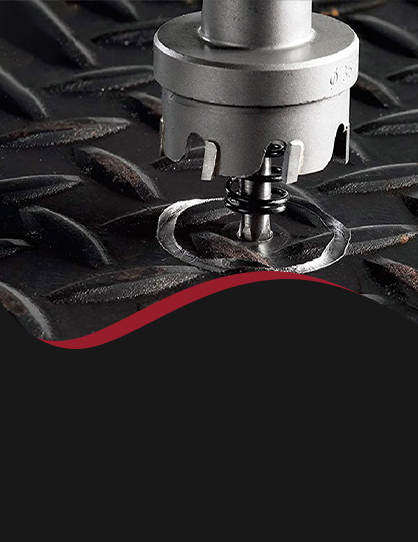
Carbide-tipped saws cut hardened steel, cast iron, and stainless. They cost more and last longer. A hole saw sets manufacturer offering carbide sets serves industrial and heavy fabrication work.
Here is what a hole saw sets manufacturer needs to deliver:
- Size range that covers the common trade requirements
- Two arbors with locking pins and quality pilot drills
- Bi-metal construction as the standard
- Case with marked slots and compartments
- Teeth set for chip clearance without binding
The Pilot Drill That Starts Every Hole
The pilot drill is the small drill bit in the center of the arbor. It enters the material first and guides the saw. A dull or bent pilot drill makes the saw wander. The hole comes out in the wrong place.
A hole saw sets manufacturer includes spare pilot drills in the kit. The pilot wears out faster than the saw. When it goes, the whole kit is useless until it is replaced. A kit with spares keeps working.
The pilot drill also has to be the right length. Too long and it punches through the back of the material before the saw finishes the cut. Too short and it does not engage before the saw teeth touch. A hole saw sets manufacturer matches the pilot length to the saw depth.
The Slug That Will Not Come Out
The slug is the disc of material the saw leaves inside itself after the cut. It has to come out before the next hole. Many saws have ejection slots in the side where a screwdriver pries the slug loose. A hole saw sets manufacturer cuts these slots at an angle so the slug tips out.
Some sets use a spring-loaded arbor that pushes the slug out automatically. The user does not stop to pry. The next hole starts immediately. A hole saw sets manufacturer offering spring ejection on the larger sizes saves time on repetitive work.
What Fails on a Cheap Set
The teeth dull after three holes in wood. The set was carbon steel sold as bi-metal. A hole saw sets manufacturer that stands behind its material choice builds trust with the buyer who reorders.
The arbor slips in the drill chuck because the shank is round instead of hex. A hole saw sets manufacturer using hex shanks prevents the slip under torque. The case cracks at the hinge and the saws spill out in the truck. A properly designed case survives.
A hole saw sets manufacturer builds the kit that puts the right hole in the right place. The sizes cover the jobs. The arbors hold the saws. The case keeps it all together. Choose a manufacturer that builds bi-metal as standard, includes spares, and designs the case for real use. The kit pays for itself the first time the right size is already in the box. That is the point.
Contact Us
Your email address will not be published. Required field are marked*

- Address: No.13, Qiaonan Road, Qingjiang Town Yueqing, Zhejiang, China
- Tel: +86-577-62260222
- FAX: +86-577-62260666
- E-mail: [email protected]
Copyright © Zhejiang Botian Tools Co., Ltd. All rights reserved.

Cutting Tools Manufacturer
