

 English
 русский
 Deutsch
Home · News · Industry News · HSS Hole Saws Factory: The Cutting Tools That Put Clean Holes in Tough Materials
Industry News
HSS Hole Saws Factory: The Cutting Tools That Put Clean Holes in Tough Materials
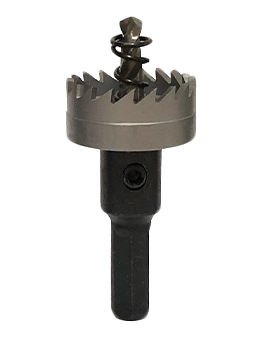
2026-08-14A hole saw is a cylinder with teeth. It spins in a drill, bites into metal or wood, and carves out a circular plug. Plumbers cut holes for pipes. Electricians open knockouts for conduit. Sheet metal workers install ductwork. A HSS hole saws factory produces these annular cutters by welding HSS tooth rings onto alloy steel bodies. The teeth handle friction heat without losing hardness. The body transfers torque from the arbor. For tool distributors and industrial buyers, the hole saw is a volume consumable that has to cut fast, last longer than the cheap option, and eject the plug without a fight.
The Teeth That Cut and the Body That Holds Them
HSS alloys like M2 and M42 hold hardness at the temperatures generated by friction cutting. M42 with cobalt extends life in stainless steel. A HSS hole saw factory uses these steels for the tooth ring and welds it to an alloy steel body. The weld matters as much as the teeth. A continuous laser or induction weld around the full circumference keeps the tooth ring attached when the saw grabs. A cold weld or skip weld cracks under torque.
Tooth geometry determines how the saw behaves in the cut. Variable pitch teeth alternate narrow and wide gullets to break up vibration. A HSS hole saw with variable pitch runs quieter and cuts rounder holes in thin sheet metal. Tooth set, the side-to-side offset of each tooth, creates clearance between the body and the workpiece. Without set, the saw binds. Too much set leaves a rough finish.
The cap at the closed end threads onto an arbor. Drive pins engage slots in the cap for positive torque transfer. Ejection slots let the operator pry out the cut slug. A HSS hole saw with a spring-loaded arbor ejects the slug automatically, which matters when the operator is cutting overhead or in a tight space.
Slugs, Chips, and the Heat They Generate
The cut slug has to exit the body after every hole. A slug stuck inside blocks the next cut. Angled ejection slots and side access holes let the operator knock out a stubborn plug. Heat management separates a saw that lasts from one that dulls in seconds. Friction at the tooth tip generates temperatures that soften even M42 steel. Cutting fluid ports in the body or external lubrication carry heat away. A HSS hole saw run dry in metal dulls fast.
Chip clearance is the other half of heat management. Gullets between teeth carry chips out of the cut. Gullets that pack full of chips stop cutting and friction-weld the chips to the teeth. Deep, polished gullets clear chips efficiently and keep the saw running cooler.
Here is what a HSS hole saw needs to perform:
- M2 or M42 HSS tooth ring with variable pitch for reduced vibration
- Alloy steel body continuously welded to the tooth ring
- Precision tooth set for clearance without binding
- Pinned arbor drive with ejection slots and spring-loaded slug ejection
- Deep gullets for chip clearance and cutting fluid access
Where These Saws Do the Work
Electricians cut through steel studs and junction boxes. A HSS hole saw in a cordless drill makes a clean round hole without the burrs a twist drill leaves. Plumbers cut stainless sinks for faucets and steel pipe for branch connections. Stainless work-hardens and kills cheap cutters. A HSS hole saw with M42 teeth holds its edge through the punishment. HVAC crews cut ductwork openings on ladders and lifts where a jigsaw is clumsy. Maintenance teams keep a kit covering 19 to 76 millimeters for whatever hole the next repair demands.
What Fails on a Budget Saw
Teeth lose set after a few holes in steel. The saw cuts undersized, tapered holes, then binds and friction-welds itself into the workpiece. The weld between the tooth ring and body cracks under the first hard grab. A HSS hole saw factory that skips post-weld heat treatment leaves residual stress in the joint. The tooth ring separates and spins independently, destroying the workpiece.
A HSS hole saw is a consumable. It cuts a predictable number of holes before the teeth dull. Choose a factory that forms M2 or M42 teeth to the right geometry, welds the ring properly, and sets the teeth for the materials the saw will cut. The holes come out round and clean. That is what the user paid for.
Contact Us
Your email address will not be published. Required field are marked*

- Address: No.13, Qiaonan Road, Qingjiang Town Yueqing, Zhejiang, China
- Tel: +86-577-62260222
- FAX: +86-577-62260666
- E-mail: [email protected]
Copyright © Zhejiang Botian Tools Co., Ltd. All rights reserved.

Cutting Tools Manufacturer
