

 English
 русский
 Deutsch
Home · News · Industry News · Hole Saw Sets Factory: The Case That Puts the Right Size in the Tradesman's Hand
Industry News
Hole Saw Sets Factory: The Case That Puts the Right Size in the Tradesman's Hand
2026-10-16A hole saw cuts a circle through wood, metal, or plastic. The tradesman rarely needs one size. The plumber needs the pipe sizes. The electrician needs the conduit sizes. The carpenter needs the lock and the dowel sizes. A hole saw sets factory builds the kit that puts the range in one case. The saws share the arbor. The pilot drill centers every cut. The case holds the sizes the trade actually uses. The set is the product, not the individual saw.
The Sizes Are Not Random
A hole saw set covers a range, but the range is not a list of every size. It is the sizes the trade reaches for. The lock installer needs 2-1/8 inches and 1 inch. The plumber needs the pipe outside diameters. The electrician needs the conduit trade sizes. The factory that builds the set around the real jobs sells more kits than the one that fills the case with odd sizes.
The arbor is the shared component. The small saws use one arbor. The large saws use another. The set includes both. A factory that designs the arbor to fit every saw in the set and hold them without wobble produces a kit the tradesman trusts.
Bi-Metal Is the Baseline
The teeth decide what the saw can cut. Carbon steel cuts wood and dulls fast in metal. Bi-metal, high-speed steel teeth welded to a spring steel body, cuts wood, plastic, aluminum, and mild steel. The bi-metal saw is the standard for the general-purpose set. The factory that builds the set in bi-metal serves the contractor who moves between materials on the same job.
The tooth set has to clear the chips. A saw with too little set binds and burns. Too much set and the cut is ragged. The factory that controls the set and the gullet depth produces a saw that cuts without grabbing.
The Pilot and the Slug
The pilot drill starts the hole and keeps the saw from walking. A dull pilot makes the saw wander and the hole ends up in the wrong place. The set includes spare pilots because the pilot wears faster than the saw. The factory that ships the spares in the kit keeps the tradesman working.
The slug is the plug of material left inside the saw. It has to come out before the next hole. The saws have ejection slots where a screwdriver pries the slug loose. Some arbors use a spring to push the slug out. The factory that designs the ejection for the real material, not the test block, builds a saw the user does not fight.
Here is what a hole saw sets factory has to deliver:
- Size range built around the trade requirements
- Arbor that fits every saw in the set and locks without wobble
- Bi-metal teeth with proper set and gullet depth
- Spare pilot drills included
- Ejection slots or spring ejection for the slug
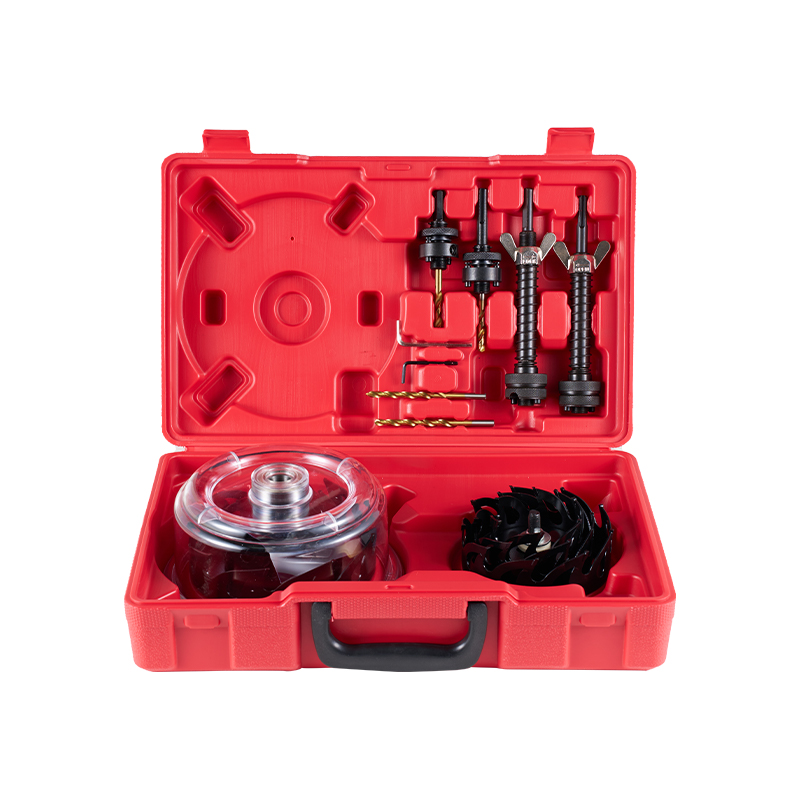
- Case that holds the saws, the arbors, and the spares
The Case Is Part of the Kit
The case has to hold the saws in marked slots, the arbors in their place, and the pilots in a separate compartment. A case that cracks at the hinge spills the saws in the truck. A case with no labels forces the user to measure every saw. The factory that designs the case for the truck, not the showroom, builds the kit that stays organized.
The Set That Sits Unused
A set with the wrong sizes sits in the truck and gets ignored. The tradesman buys the individual saws anyway. The factory that studies the trade and builds the set around the actual jobs sells the kit that gets used.
A hole saw set is a case of saws, arbors, and pilots. The sizes, the teeth, and the case decide whether the kit earns its place. Choose a factory that builds the set for the trade, not for the catalog page.
Contact Us
Your email address will not be published. Required field are marked*

- Address: No.13, Qiaonan Road, Qingjiang Town Yueqing, Zhejiang, China
- Tel: +86-577-62260222
- FAX: +86-577-62260666
- E-mail: [email protected]
Copyright © Zhejiang Botian Tools Co., Ltd. All rights reserved.

Cutting Tools Manufacturer
